

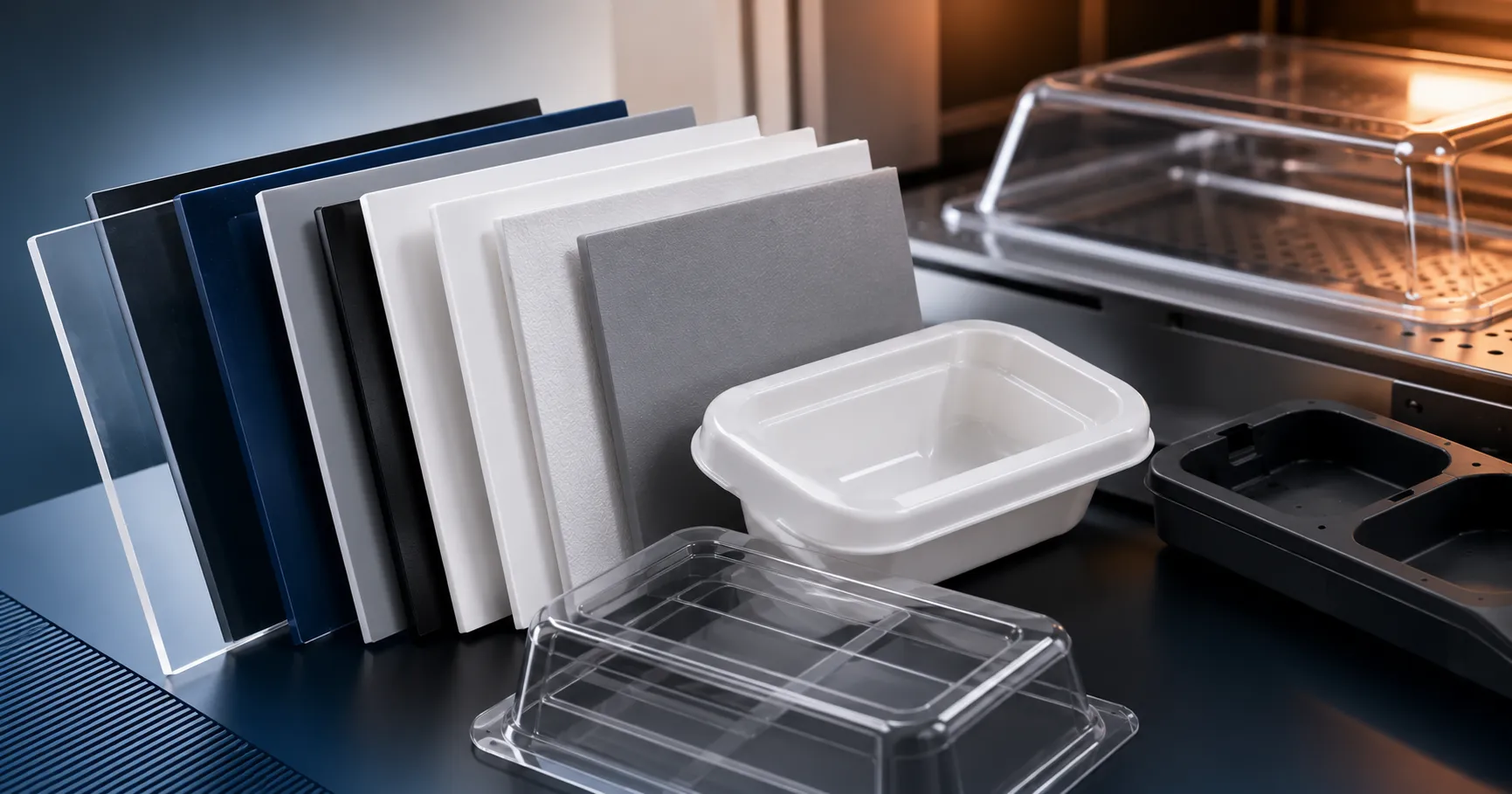
Choosing Plastic Sheets for Thermoforming: Which Material is More Suitable?
Selection of plastic sheets for thermoforming., Choosing the right plastic sheet is a critical decision in terms of the durability, surface quality, forming performance, cost, and lifespan of the part to be produced. Different plastic sheets such as ABS, HIPS, PMMA/ABS, PMMA, ASA/ABS, and PE offer different advantages depending on the application, part geometry, and expected performance.
TRUE thermoformed plastic sheet When this method is chosen, production quality improves while waste rates, process problems, and cost per part can be kept under control. So, which plastic sheet should be preferred for which application?
This article compares the main plastic sheets used in thermoforming production and explains the points to consider when selecting materials.
What is Thermoforming?
Thermoforming is a process of shaping a thermoplastic sheet by heating it in a controlled manner over a mold, and then cooling it to obtain the final part.
In methods such as vacuum thermoforming and pressure thermoforming, the homogeneous heating of the sheet, mold design, and the forming properties of the material directly affect the final product quality.
Therefore, it is not correct to choose materials based solely on the price of the panel. How the sheet behaves during thermoforming and how well the final part is suited to the operating conditions. They should be evaluated together.
What should be considered when choosing plastic sheets for thermoforming?
Before selecting a plastic sheet, the following criteria should be considered:
- The intended use of the part
- Required mechanical strength
- Impact resistance
- Operating temperature
- Chemical and moisture resistance
- Surface appearance
- Plate thickness
- The depth and geometry of the part
- Mold type
- Number of products
- Target cost per unit
- Next steps
- Color and surface texture
For example, the specifications required for automotive interior trim parts are not the same as those required for refrigerator interior lining. Therefore... Thermoforming sheet selection should be specific to the application.
ABS Sheet: Durability and Thermoforming Performance
ABS is one of the most frequently preferred engineering plastics in thermoforming applications.
ABS sheet, Thanks to its high impact resistance, good formability, and wide range of surface options, it can be used in automotive, white goods, bathroom, medical, and various industrial applications.
Key features of ABS:
- High impact resistance
- Good thermoforming capability.
- Different surface textures
- Wide range of color options.
- Good mechanical strength
- Suitable for CNC, drilling and other secondary processing.
ABS is a strong option, especially for manufacturers who want to produce thermoformed parts that are both durable and aesthetically pleasing.
Keyplas's ABS sheet solutions are available in various thicknesses, colors, and surface options and are used in automotive, bathroom, medical, industrial, and other applications.
[View ABS Sheet product page →]
HIPS Board: A Lightweight and Economical Solution
HIPS, or high-impact polystyrene, stands out as an economical and processable alternative in thermoforming applications.
Especially in the production of parts with large surface areas, the lightness of the material can provide a significant advantage.
Some applications where HIPS panels can be preferred:
- Refrigerator and cooler interior parts
- Home appliance components
- Interior linings
- Advertising and display products
- Industrial parts
- Various thermoforming applications
HIPS can be considered for applications where production cost is important and high impact performance at the ABS level is not required.
PMMA/ABS Sheet: Aesthetic Surface and Mechanical Strength
In some applications, mechanical strength alone is not sufficient. The outer surface of the part must also meet expectations in terms of scratch resistance, chemical resistance, and visual quality.
at this point PMMA/ABS sheet, It stands out as a solution that combines the advantages of two different materials.
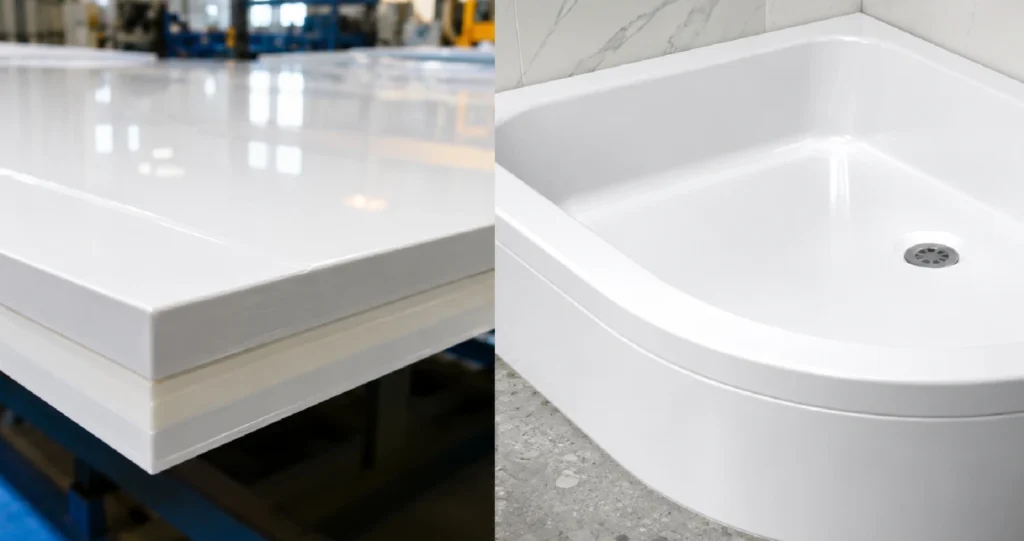
Made of PMMA/ABS:
- The ABS layer contributes to the mechanical properties.
- The PMMA surface layer provides both aesthetic appearance and surface performance.
- Complex geometries can be created using thermoforming.
- A high-quality appearance can be achieved on the outer surface of the part.
Therefore, PMMA/ABS is preferred, especially in automotive, bathroom, white goods, and various industrial parts with visible surfaces.
ASA/ABS Sheet: Outdoor Applications
Material selection becomes even more important in applications where the part is exposed to sunlight and outdoor conditions.
ASA/ABS sheet, ABS can be used to take advantage of its thermoforming and mechanical properties, as well as ASA's outdoor performance.
Especially:
- Outdoor equipment
- Caravan parts
- Automotive applications
- Commercial vehicle parts
- Exterior cladding elements
It can be used in applications such as these.
For outdoor applications, it's necessary to consider not only the material name but also the actual usage conditions of the part, color selection, UV expectations, and surface requirements.
When should PMMA sheet be preferred?
PMMA is preferred in applications where transparency or visual quality is paramount due to its high light transmittance and glass-like appearance.
PMMA sheet especially:
- Transparent lids
- Visual equipment
- Lighting applications
- Decorative pieces
- Display products
It can be used in areas such as these.
However, when choosing between PMMA and ABS, one should consider not only the appearance of the part but also its mechanical requirements and the thermoforming process.
PE Sheet: Applications Where Chemical Resistance is Important
Polyethylene (PE) can offer advantages, particularly in applications where chemical resistance, moisture resistance, and impact performance are important.
PE sheets can be used in industrial equipment, tank and coating applications, and various technical applications.
However, PE's thermoforming behavior is not the same as ABS or HIPS. Therefore, existing machine, mold, and process parameters must also be considered in material selection.
Which Thermoforming Sheet Should I Choose?
The table below can help you make a basic material selection:
| Application requirement | Materials that can be evaluated |
|---|---|
| High impact resistance | ABS |
| Economical thermoforming solution. | HIPS |
| Aesthetic exterior | PMMA/ABS |
| Outdoor application | ASA/ABS |
| Transparent and aesthetically pleasing appearance. | PMMA |
| Chemical resistance | PE |
| Automotive parts | ABS, PMMA/ABS, ASA/ABS |
| White goods | ABS, HIPS |
| Bathroom and bathtub | ABS, PMMA/ABS |
| Caravan applications | ABS, ASA/ABS |
| Industrial parts | ABS, PE and other suitable thermoplastics for the application. |
This table should be used for preliminary selection purposes only. Final material selection should be made based on the part geometry, operating conditions, thickness, mold structure, and manufacturing process.
How is the thickness of plastic sheets determined?
In thermoforming applications, determining sheet thickness solely based on the thickness of the final part is inaccurate.
During forming, the material thins in some areas. Especially in deep-drawn parts, variations in wall thickness that may occur in corner and base regions must be taken into consideration.
Therefore, when determining the plate thickness:
- The part geometry should be examined.,
- The withdrawal rate should be evaluated.,
- Minimum wall thickness should be determined in critical areas,
- The thermoforming behavior of the material must be taken into consideration.,
- Trial production should be carried out.
Choosing the correct sheet thickness directly affects both product performance and material cost.
Why is sheet quality important in thermoforming production?
Two sheets made from the same type of polymer may not yield the same results in terms of production performance.
The plate:
- Thickness homogeneity
- Surface quality
- Color stability
- Layer structure
- Raw material quality
- Thermoforming behavior
- Party continuity
These characteristics can affect the production outcome.
Especially in mass production, small differences in sheet quality can turn into bigger problems after molding. Therefore, it is important to work with a sheet manufacturer that has regular and traceable production.
How to Choose the Right Sheet for Thermoforming?
The best way to make the right choice is to evaluate the application together with the manufacturer, rather than deciding solely based on the catalog.
At Keyplas, we meet our customers' needs;
part → application area → material → sheet thickness → surface → thermoforming process
We evaluate them in order of ranking.
If necessary, materials suitable for mass production can be selected through sample and technical evaluation.
Keyplas offers solutions for automotive, white goods, medical, defense, refrigeration, bathroom and industrial applications with different plastic sheet solutions such as ABS, ABS/PMMA, HIPS, PMMA, ASA/ABS and PE.
Conclusion: Which Thermoforming Sheet is Best?
There is no single “best” thermoforming plastic sheet. The most suitable material is..., It is the material that best suits the operating conditions and production process of the part to be manufactured.
ABS is a strong option in many industrial applications due to its high impact resistance and thermoforming performance, while HIPS offers economical solutions, PMMA/ABS provides aesthetic surface and mechanical performance, ASA/ABS is suitable for outdoor applications, PMMA is for visual and transparent applications, and PE is considered for applications requiring chemical resistance.
If you are unsure which plastic sheet is more suitable for your project, you can share your part drawing or technical requirements with the Keyplas team to find the right one for your application. thermoformed sheet You can consider these options together.
Keyplas – Plastic Sheet and Thermoforming Solutions
For more technical information on the types of plastics that can be used in thermoforming and the effects of material selection on the process, see [link to relevant documentation]. ScienceDirect – Thermoforming Overview You can examine the scientific source.