

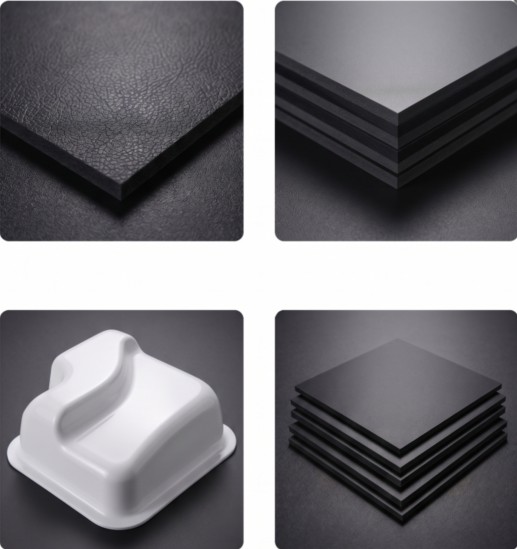
The Advantages and Procurement Benefits of Thermoforming Polystyrene (PS) Sheets
Thermoforming polystyrene sheets offers both cost and time advantages to production processes. The PS sheet, which softens with heat, quickly takes its final form through the application of vacuum or pressure on a mold; this simple yet controlled process protocol ensures consistency in mass production. Below, I would like to explain the main advantages offered by thermoforming and the points to consider during its application.
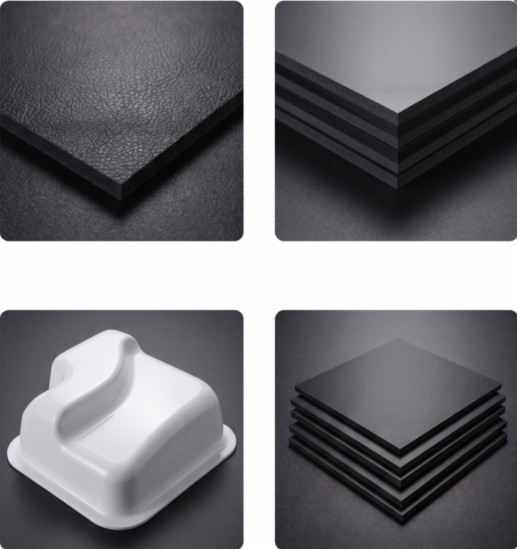
The most significant advantage of thermoforming is its production speed. Since the steps of heating, placing in a mold, cooling, and edge cutting a sheet can be performed in series, the time per part is quite short. This enables quick order turnaround in small and medium-sized businesses and meets urgent production needs. Furthermore, the ability to produce a large number of parts per mold reduces the cost per part.
Another advantage is design flexibility. The fluidity of polystyrene material and the nature of thermoforming techniques allow for the economical production of parts with interlocking details, curved surfaces, and lightweight support elements. Thus, the transition from prototyping to mass production requires fewer revisions. Through radius applications and wall thickness control in design, it is possible to obtain parts that are both aesthetically pleasing and functional.
Surface quality and visual consistency are also among the advantages achieved with thermoforming. When the appropriate mold surface (glossy or matte surface finish) is selected, PS sheets are formed with high surface gloss or the desired texture. This ensures visual consistency in both the packaging industry and advertising products. The external appearance of the product offers a standard surface before printing and lamination; this reduces finishing costs and labor requirements.
Thermoforming is also practical in terms of waste management and cost optimization. When sheet cutting planning is done intelligently, the waste rate decreases; material efficiency increases with increased production volume. Thanks to mold amortization and production process optimization, long-term operating profit increases. At this point, improving material supply relationships and cutting arrangements by manufacturers makes a significant contribution.
The repeatability of the production process is a major advantage in terms of quality assurance. When thermoforming parameters (heat, vacuum time, cooling time) are controlled, part tolerances show low deviations in mass production. This ensures consistent performance, especially in sensitive applications such as food packaging or functional parts. Suitable PS products used in applications requiring food contact, when supported by the necessary certifications, ensure delivery in compliance with industry standards.
There are also technical advantages to consider in practice: correct thickness selection, even heating, and sufficient cooling sequence directly affect work efficiency. Modularity and ease of maintenance in mold design reduce downtime in the production line. Furthermore, preparing in advance for different surface textures and lamination requirements prevents future incompatibilities.
For manufacturers and suppliers, working with reliable business partners is crucial to making the most efficient use of these advantages. Keyplas offers application-specific solutions in PS sheet supply, meeting manufacturers' needs with options for thickness, surface finish, and food compatibility. Providing technical support for thermoforming line setup or parameter optimization also increases efficiency.
In conclusion, thermoforming polystyrene sheets offers significant advantages in production in terms of speed, cost, design flexibility, and repeatability. Successful application requires the right material selection, careful temperature control, and appropriate mold design. If you wish to optimize materials and molds according to your project needs, the Keyplas technical team can provide application consultancy. Supplier collaboration plays a critical role in improving your production processes and maximizing the advantages of thermoforming; Keyplas' experience in this area will be beneficial.
Note: The technical terms and process steps mentioned in this text can be detailed on an application-by-application basis; optimizing parameters according to field conditions yields the best results. If you require project-based support, Keyplas You can contact us to request samples and detailed information.
In polystyrene sheet thermoforming applications, material selection and temperature control directly affect production quality. When the appropriate thickness and surface finish are selected, parts are formed homogeneously; precise details are obtained with combinations of vacuum and positive pressure. Optimizing mold cooling reduces the risk of deformation and increases part strength. In mass production, cutting layout and material usage should be planned to reduce waste. Such optimizations increase production efficiency and reduce costs.
For more detailed information and material requests, please contact Keyplas. contact You can pass.